Embroidery >>> Ancient Embroidery Photos >>>
The Sun.
The Ladies of Fertility >>>>
Birds >>>>
Sun Shallop/Chariot >>>>
|
|
...Russian village people thought the Sun was the reason of life and the world as a whole. The very word "sun" (solnce in Russian) is derived from Sanskrit word "su" ("to create", "to give birth") ...
a dictionary of embroidered symbols, The Sun >>>>
|
|
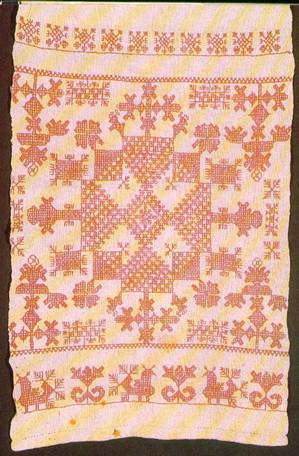
|
|
- From:
- Olonec region
- Time:
- 1890s-1910s.
- What is it:
- a towel edge.
- Embroidery technique:
- "painting"-stitch, feather stitch, cross-stitch.
- Acquired by
- an ethnographic expedition to Karelia, 1939.
|
|
Main pattern is a solar wheel with "Trees of Life" in corners.
Upper frieze : minor solar rosettes, down frieze : "Trees of Life" separated by "sun birds".
|
|
|
|
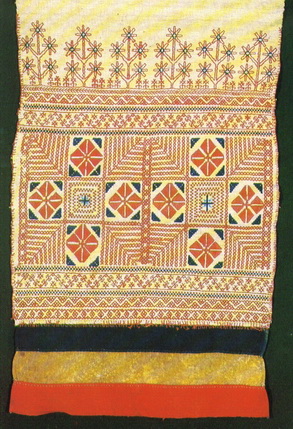
- From:
- Orel region, Sredne-Novosilsky district
- Time:
- 1890s.
- What is it:
- a towel edge.
- Embroidery technique:
- feather stitch, cross-stitch.
- Author:
- Z.E.Bykovskaya, a village craftswoman.
|
|
The major all-over pattern consists of large hooked diamond forms containing saltire crosses. "Trees of Life" are in corners.
Frieze: "Trees of Life", minor sun rosettes, and "Holy Water" (white zig-zag).
|
|
|
|
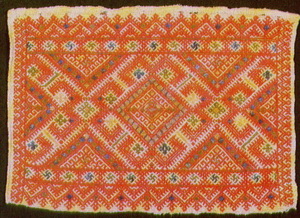
- From:
- Olonec region, Kargopol district.
- Time:
- 1810s-1830s.
- What is it:
- shoulder detail of a woman's dress.
- Embroidery technique:
- nabor (weaving stitch), satin stitch, feather stitch.
- From a private collection of
- M.F.Yakunchikova and N.Ya.Davydova
|
|
The major design is of two saltire crosses forming pectinate and hooked diamonds.
Frieze: swastikas and anthropomorphic figures (Rozhanicy goddesses - Ladies of Fertility).
|
|
|
|
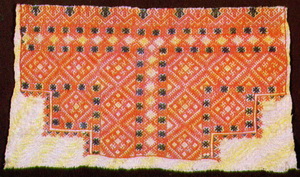
- From:
- Olonec region
- Time:
- 1810s-1830s.
- What is it:
- shoulder detail of a woman's dress.
- Embroidery technique:
- nabor (weaving stitch), feather stitch.
- From a private collection of
- M.F.Yakunchikova and N.Ya.Davydova
|
|
Diamonds ("a seeded grain field") with swastikas (a symbol of the Sun) inside. The upper frieze consists of stylized figures of Rozhanicy - Ladies of Fertility, Mothers of the World.
|
|
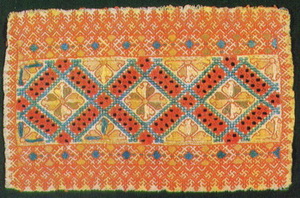
|
|
- From:
- Olonec region
- Time:
- 1810s-1830s.
- What is it:
- shoulder detail of a woman's dress.
- Embroidery technique:
- nabor (weaving stitch), "painting"-stitch, satin stitch, feather stitch.
|
|
|
|
|
|
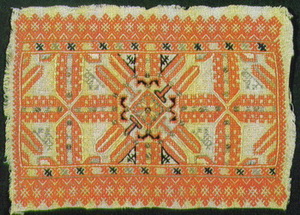
- From:
- Olonec region, Kargopol district
- Time:
- 1840s-1860s.
- What is it:
- shoulder detail of a woman's dress.
- Embroidery technique:
- nabor (weaving stitch), "painting"-stitch, satin stitch, feather stitch.
- From a private collection of
- M.F.Yakunchikova and N.Ya.Davydova
|
|
|
|
|
|
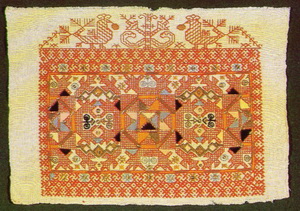
- From:
- Olonec region
- Time:
- 1850s-1890s.
- What is it:
- shoulder detail of a woman's dress.
- Embroidery technique:
- nabor (weaving stitch), "painting"-stitch, satin stitch, feather stitch.
- From a private collection of
- M.F.Yakunchikova and N.Ya.Davydova
|
|
Incorporated in the major all-over pattern are squares, diamond-forms, rosette-filled octagons and sun signs.
Repeat motif of anthropomorphic figures (Rozhanicy goddesses) and swastikas are seen in the border.
Arranged in the frieze are two confronted peacocks on either side of a highly stylized Tree of Life.
|
|
|
|
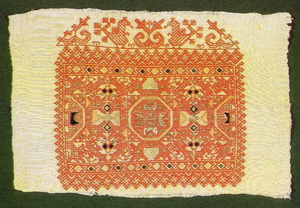
- From:
- Olonec region, Kargopol district
- Time:
- 1810s-1830s.
- What is it:
- shoulder detail of a woman's dress.
- Embroidery technique:
- nabor (weaving stitch), "painting"-stitch, satin stitch, feather stitch.
- From a private collection of
- M.F.Yakunchikova and N.Ya.Davydova
|
|
The major all-over design included a central rossete-filled octagon accompanied by boat- and cross-shaped forms, swastikas, rosettes and birds.
The border is filled with swastikas and anthropomorphic figures (Rozhanicy goddesses).
Arranged in the frieze are two confronted peacocks on either side of a highly stylized Tree of Life.
|
|
|
|
- From:
- Olonec region, Kargopol district
- Time:
- 1810s-1830s.
- What is it:
- shoulder detail of a woman's dress.
- Embroidery technique:
- nabor (weaving stitch), "painting"-stitch, satin stitch, feather stitch.
- From a private collection of
- M.F.Yakunchikova and N.Ya.Davydova
|
|
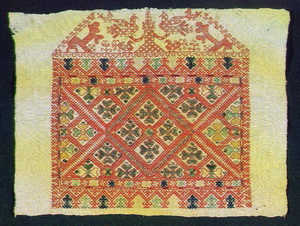
A regular net with four-petaled rosettes within each diamond is framed by anthropomorphic figures (Rozhanicy goddesses), diamonds with latch hooks and swastikas.
Set in the frieze is a formalized female figure (Mother of the World) holding peacocks in their risen arms.
|
|
|
|
- From:
- Olonec region, Kargopol district
- Time:
- 1810s-1830s.
- What is it:
- shoulder detail of a woman's dress.
- Embroidery technique:
- nabor (weaving stitch), "painting"-stitch, satin stitch, feather stitch.
- From a private collection of
- M.F.Yakunchikova and N.Ya.Davydova
|
|
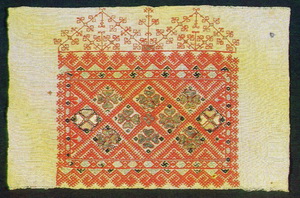
A regular diamond-shaped net containing four-petalled rosettes is the major pattern framed by swastikas and plant subjects.
The frieze ornamentation is of a highly stylized Tree of Life.
|
|
|
|
- From:
- Olonec region, Kargopol district
- Time:
- 1810s-1830s.
- What is it:
- shoulder detail of a woman's dress.
- Embroidery technique:
- nabor (weaving stitch), "painting"-stitch, satin stitch.
- From a private collection of
- M.F.Yakunchikova and N.Ya.Davydova
|
|
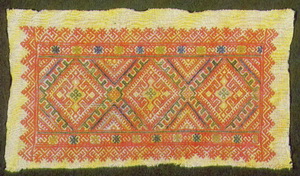
The ornamental panel contains various diamond-forms and anthropomorphic figures of half-height.
The border is composed of S-shaped forms and Rozhanicy goddesses as female Elk (horizontal border) and Mothers (vertical border).
(two forms of Rozhanicy, more info >>>>)
|
|
|
|
- From:
- Olonec region, Kargopol district
- Time:
- 1810s-1830s.
- What is it:
- shoulder detail of a woman's dress.
- Embroidery technique:
- nabor (weaving stitch), "painting"-stitch, satin stitch.
- From a private collection of
- M.F.Yakunchikova and N.Ya.Davydova
|
|
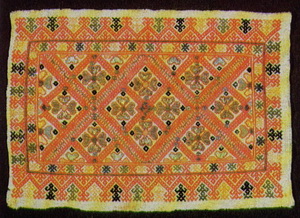
The main pattern is a regular diamond-shaped net containing four-petalled rosettes.
The framing ornamentation shows Rozhanicy goddesses and stylized elk's heads.
|
|



